

Supplying PPE and Tools in Manufacturing Facilities with Industrial Vending
Updated: Aug 14
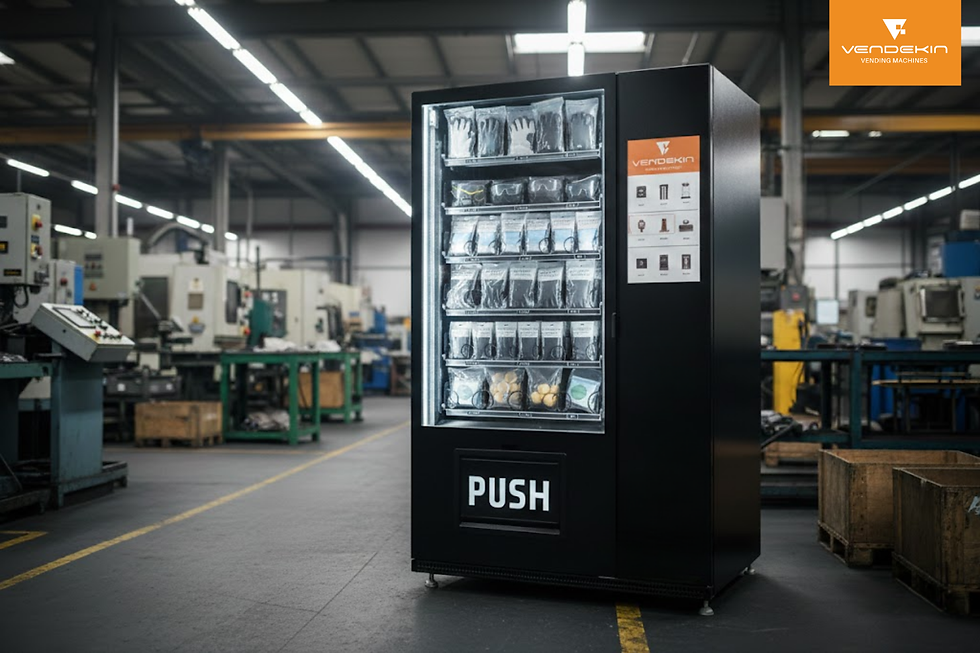
Manufacturing environments demand precision, accountability, and safety. Whether it is a production line, warehouse, or heavy engineering facility, access to the right tools and protective equipment at the right time directly affects productivity and compliance.
This is where industrial vending machines play a strategic role. For manufacturing heads and safety managers, industrial vending is not about snacks or convenience. It is about controlled distribution of PPE, tools, and critical supplies within a high-performance environment.
The Challenge of PPE and Tool Management
In many manufacturing facilities, PPE and tools are stored in central rooms or issued manually. This often leads to:
Delays in access
Overstocking or understocking
Lack of usage tracking
Increased shrinkage or loss
Limited visibility into consumption patterns
When safety gloves, helmets, or specialized tools are unavailable at the moment they are needed, operations slow down. When items are over-issued without tracking, costs escalate.
Industrial vending machines solve these issues through controlled, data-driven distribution.
What Are Industrial Vending Machines?
Industrial vending machines are smart, secure units installed directly on factory floors or within production zones.
Unlike traditional vending systems, these machines are designed to dispense:
Personal protective equipment such as gloves, masks, goggles, and helmets
Maintenance, repair, and operations tools
Consumables like drill bits or cutting tools
Safety supplies and small industrial components
Each transaction is digitally recorded, creating accountability and real-time visibility.
Improving Safety Compliance
Safety managers are responsible for ensuring that employees use appropriate protective gear. Industrial vending machines support this responsibility by:
Tracking item issuance per employee
Limiting access to authorised personnel
Monitoring replenishment cycles
Ensuring PPE is consistently available
By placing PPE vending machines close to production lines, facilities encourage compliance without adding friction.
Controlled access reduces overconsumption and supports documented safety procedures.
Reducing Operational Downtime
Time lost searching for tools or waiting for manual approval affects productivity.
Industrial vending machines installed within work zones allow employees to retrieve essential tools quickly. With cashless or badge-based access, the process is seamless.
Real-time inventory monitoring ensures that critical tools are restocked proactively. This reduces downtime and prevents unexpected shortages during peak production periods.
Data-Driven Inventory Control
One of the most significant advantages of industrial vending machines is visibility.
Smart vending infrastructure connected to vending machine software provides:
SKU-level tracking
Usage patterns by department or shift
Alerts for low inventory
Insights into abnormal consumption
For manufacturing heads, this data enables better forecasting and purchasing decisions. Instead of bulk over-ordering, facilities can align procurement with actual demand.
Controlling Shrinkage and Tool Loss
Tool loss and untracked PPE usage increase operational costs. Industrial vending introduces controlled dispensing and digital audit trails.
Each item withdrawal is recorded, helping facilities:
Reduce internal shrinkage
Identify patterns of overuse
Maintain accurate stock records
Support accountability across teams
This structured control enhances cost management without compromising accessibility.
Supporting Lean Manufacturing Practices
Lean manufacturing focuses on eliminating waste and improving efficiency. Industrial vending machines align with these principles.
By ensuring that tools and PPE are available only when needed and tracked precisely, facilities reduce:
Excess inventory
Manual distribution processes
Administrative overhead
This streamlined approach supports continuous improvement initiatives across production environments.
Strategic Placement in Manufacturing Facilities
Placement of industrial vending machines influences performance.
High-impact areas include:
Near production lines
At maintenance stations
In warehouse zones
Adjacent to high-risk work areas
Visible, well-positioned machines encourage proper usage and simplify access for workers.
Integration with Smart Manufacturing Systems

Modern manufacturing facilities increasingly adopt connected technologies. Industrial vending machines can integrate into broader operational ecosystems.
When paired with vNetra, managers gain centralized visibility across multiple facilities. This supports multi-site standardization and scalable deployment.
For technology-forward manufacturing environments, industrial vending becomes part of a connected operational framework.
Enhancing Cost Transparency for Manufacturing Heads
Manufacturing leaders require clear cost insights.
Industrial vending machines provide:
Accurate tracking of PPE and tool usage
Department-level reporting
Clear data for budgeting and forecasting
This transparency enables better financial planning and justifies investments in safety and operational efficiency.
Vendekin’s Approach to Industrial Vending
Vendekin designs industrial vending machines to meet the operational realities of manufacturing facilities. Robust hardware, controlled dispensing mechanisms, and integrated software support reliable performance in demanding environments.
By combining smart vending technology with centralized monitoring, facilities gain visibility, accountability, and scalable control over PPE and tool distribution.
What This Means for Safety Managers
For safety managers, industrial vending machines strengthen compliance, ensure consistent PPE availability, and provide documented tracking. They reduce risk while maintaining ease of access.
What This Means for Manufacturing Heads
For manufacturing leaders, industrial vending delivers measurable efficiency gains. It reduces downtime, improves inventory accuracy, and supports lean operations without adding administrative complexity.
Conclusion
Manufacturing facilities require precision in every aspect of operations, including how tools and protective equipment are managed. Industrial vending machines provide a structured, intelligent solution for distributing PPE and tools while maintaining full visibility and control.
For manufacturing heads and safety managers, industrial vending is not just a convenience upgrade. It is a strategic investment in safety, efficiency, and operational accountability.


Comments